Somatic Exercises for Stress Relief: How to Release Tension Stored in Your Body
Your body holds the score. Learn how somatic exercises release physical tension stored by chronic stress and trauma — and build lasting nervous system resilience.
By RelaxFrens Team
June 24, 2026
13 min read
You've tried talking about your stress. You've tried thinking your way out of it. But your shoulders still sit up around your ears, your jaw still clenches, your diaphragm still seizes. That's because stress is not only a mental phenomenon — it is a physiological event stored in the tissues of your body. Somatic exercises address stress where it actually lives.
Somatic approaches have moved from the fringes of alternative wellness into the mainstream of trauma therapy and stress medicine. Practitioners like Dr. Peter Levine (Somatic Experiencing), Dr. Bessel van der Kolk (author of "The Body Keeps the Score"), and Dr. Stephen Porges (Polyvagal Theory) have established a rigorous scientific foundation for body-based healing. This guide makes those principles accessible and practical. For the broader nervous system context, see our complete regulation guide.
Why Stress Gets Stuck in the Body
When you experience stress or threat, your nervous system prepares for fight-or-flight: muscles tense to prepare for movement, stress hormones flood your system, breathing shallows, digestion pauses. In a genuinely threatening situation, you would run or fight — physically completing the stress cycle and discharging those hormones through action.
Modern stressors don't allow this completion. You can't run from a toxic email. You can't fight your way through a difficult meeting. So the stress response is activated but never discharged. The tension, hormones, and interrupted survival energy remain stored in the body. Repeated over months and years, this creates chronic physical patterns: chronically tense shoulders, a perpetually clenched jaw, a diaphragm frozen in mid-breath, hips that feel impenetrable.
Where stress commonly gets stored:
Jaw (TMJ)
Clenching from suppressed anger, unexpressed words, perfectionism
Shoulders and neck
Carrying excessive responsibility; hypervigilance
Diaphragm and chest
Grief, anxiety, emotional suppression — restricts full breathing
Hips and psoas muscle
Fear, trauma, flight response — the psoas is the body's primary fight-or-flight muscle
Lower back
Financial stress, feeling unsupported, boundary violations
8 Somatic Exercises for Stress Relief
Progressive Muscle Relaxation (PMR)
Systematically tense each muscle group as tightly as you can for 5 seconds, then release completely. The deliberate tension followed by release teaches the nervous system what muscular relaxation actually feels like — many chronically stressed people have lost this reference point. Start at feet, move to calves, thighs, glutes, abs, hands, arms, shoulders, face.
Practice: 15–20 minutes. Excellent before sleep. Works for anxiety and insomnia.
Therapeutic Shaking (TRE-Inspired)
Lie on your back with knees bent and feet flat, hip-width apart. Slowly walk your feet toward your body until your legs begin to naturally tremble. Allow the trembling rather than suppressing it — this is the body's natural stress-discharge mechanism that stress researcher David Berceli describes as Tension and Trauma Releasing Exercises (TRE). Animals do this automatically after a threat passes.
Practice: 5–10 minutes. Can be emotionally releasing — stop if you feel overwhelmed.
Hip-Opening Movement
The psoas muscle — which runs from your lumbar spine through your pelvis to your femur — is nicknamed 'the fight-or-flight muscle' because it contracts reflexively under threat. Gentle hip-opening stretches (pigeon pose, low lunge, figure-4 stretch) directly release psoas tension and, for many people, produce unexpected emotional releases.
Practice: 10 minutes daily. Hold each stretch for 2–3 minutes with slow, deep breathing.
Jaw and Face Release
Place your fingertips lightly on your jaw joint and gently open your mouth wide, then close slowly. Repeat 10 times. Then perform slow clockwise and counterclockwise jaw circles. Finish by loosening your face completely — allow your eyes to soften, your cheeks to drop, your forehead to uncrease. Most people are shocked by how much tension they were holding.
Practice: 5 minutes. Can be done anywhere.
Somatic Body Scan Meditation
Different from standard body scan: rather than just noticing sensations, you breathe directly into areas of tension. When you find a tense area, breathe in and imagine the breath going directly into that spot. On the exhale, visualize the tension softening and dissolving. This active somatic approach accelerates physical release.
Practice: 15–20 minutes lying down. Guided versions available in AI meditation apps.
Diaphragmatic Breathing with Hands
Place one hand on your chest and one on your belly. Breathe so that only the belly hand rises on the inhale — the chest hand stays still. This direct training of diaphragmatic breathing unlocks the shallow breathing pattern that chronic stress creates, restoring full respiratory capacity.
Practice: 5 minutes, 3 times daily. Can feel unfamiliar at first if chest breathing is habitual.
Mindful Walking as Somatic Practice
Walk at half your normal pace, placing deliberate attention on the sensory experience of movement — the rolling of your foot, the swing of your arms, the rhythm of your breath. This combines the somatic benefits of movement with mindfulness. Read our complete guide to <Link style={{color:'#4CAF50', fontWeight: 600, textDecoration:'none'}} href='/blog/walking-meditation-how-to-find-peace-on-the-go'>walking meditation</Link> for more.
Practice: 15–20 minutes daily outdoors.
Cold Water Somatic Reset
End your shower with 30–60 seconds of cold water. The acute cold exposure triggers a somatic state change — it discharges sympathetic activation, stimulates the vagus nerve, and forces full-body present-moment awareness. Combined with deep breathing, it completes the stress response cycle.
Practice: 30–60 seconds. Gradual temperature reduction for beginners.
Frequently Asked Questions
What are somatic exercises?
Somatic exercises are body-based practices that access and release tension, trauma, and stress stored in the physical body. Unlike talk therapy or cognitive approaches, somatic exercises work directly with the body's nervous system through movement, sensation, and breath.
Can stress really be stored in the body?
Yes. When the stress response is activated but not discharged through physical action, the residual tension and hormones remain stored in the body — particularly in the hips, shoulders, jaw, and diaphragm. This is why people often feel emotional release during massage or intense stretching.
Are somatic exercises safe for trauma survivors?
Somatic exercises are generally gentle and safe, but people with significant trauma histories should ideally work with a trained somatic therapist, especially for practices involving intense sensation or shaking. Gentle body scan meditation and mindful movement are accessible starting points.
Guided Somatic Practices with RelaxFrens
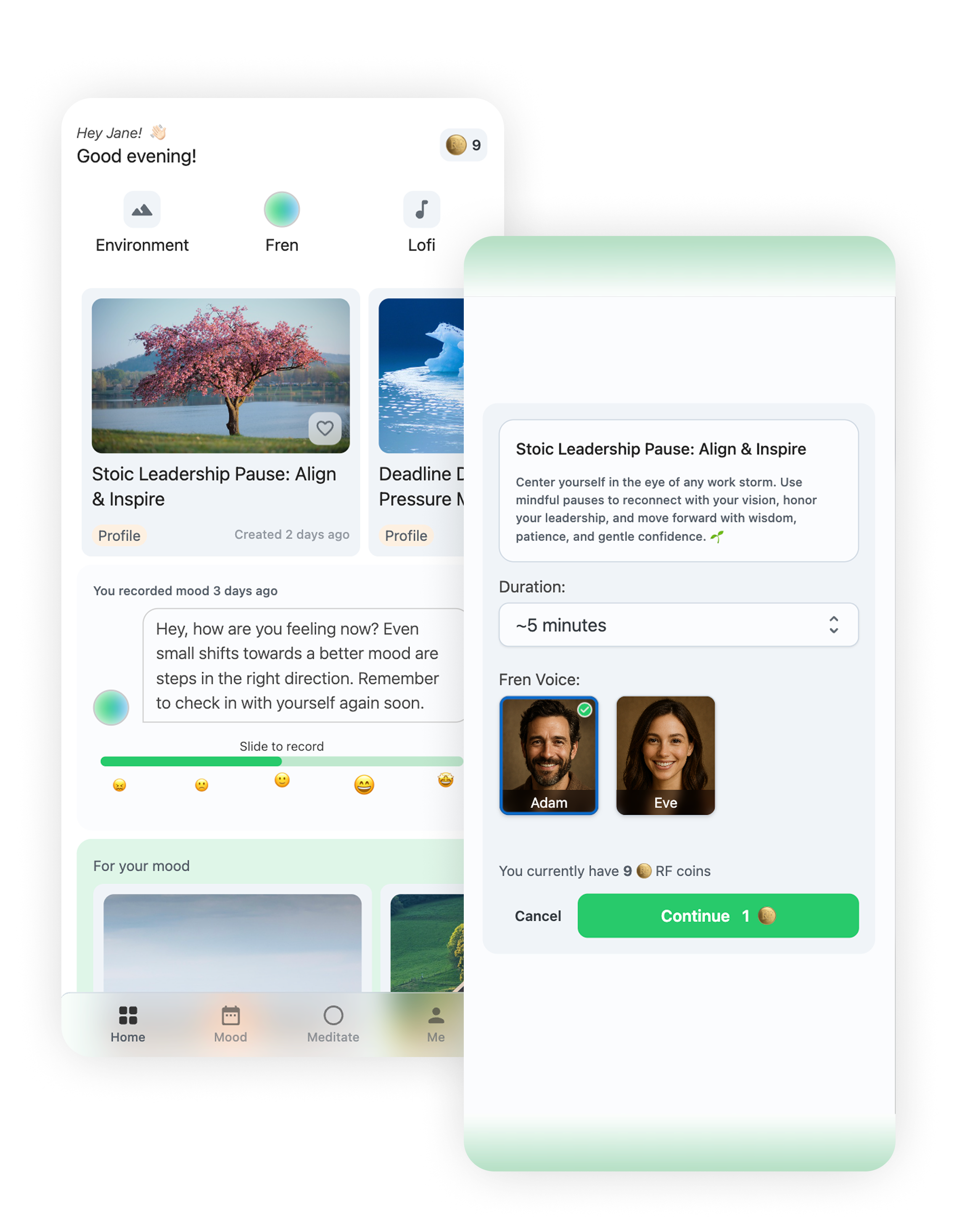
RelaxFrens AI guides you through body scan meditation, breathing exercises, and mindful movement — adapting to your current stress level and body awareness.
Conclusion
Somatic exercises offer something that purely cognitive approaches cannot: direct access to stress patterns stored in the body's tissues and nervous system. Progressive muscle relaxation, therapeutic shaking, hip openers, and mindful movement complete the stress response cycles that modern life leaves unfinished, restoring genuine physical ease rather than just mental reframing.
Integrate these practices alongside AI-guided meditation and the nervous system regulation techniques covered in our other guides for a complete mind-body stress relief practice.
If this was useful, pass it along to someone who might need it.

Start a personalised meditation practice
An AI meditation app that builds customised sessions for your mood, stress, and sleep.
Ready to try a personalised meditation app?
RelaxFrens is an AI meditation app that creates customised sessions for your mood, stress, and sleep — not a fixed catalogue of the same tracks.
30-day money-back guarantee · Cancel anytime