Nervous System Regulation: The Complete 2026 Guide to Calm Your Body and Mind
Master polyvagal theory, breathwork, and mindfulness to shift out of chronic stress and build a resilient, regulated nervous system.
By RelaxFrens Team
June 25, 2026
16 min read
You can't think your way out of a dysregulated nervous system. That's the fundamental insight that has reshaped mental health care in the last decade — and it's why understanding nervous system regulation has become the most important wellness skill of 2026. From chronic anxiety to burnout to emotional volatility, the root cause is often a nervous system that has lost its ability to return to baseline.
This guide draws on polyvagal theory, somatic neuroscience, and breathwork research to give you a complete, practical framework for regulating your nervous system — no prior knowledge required. You'll also see how AI-powered meditation apps are making daily regulation dramatically more accessible.
Understanding Your Nervous System: The Three States
Polyvagal theory, developed by neuroscientist Dr. Stephen Porges, describes three physiological states that govern how we feel and behave:
Ventral Vagal (Safe & Social)
The optimal state. You feel calm, connected, curious, and engaged. Your body is relaxed but alert. This is the state we're trying to spend more time in through regulation practices.
Sympathetic (Fight-or-Flight)
Activated by perceived threat. Heart rate rises, muscles tense, digestion slows. Useful in genuine danger, but chronic activation — from work stress, relationship conflict, or unprocessed trauma — causes anxiety, irritability, and burnout.
Dorsal Vagal (Shutdown/Freeze)
Activated when threat feels overwhelming and inescapable. You feel numb, disconnected, exhausted, and hopeless. Often experienced as depression, dissociation, or chronic fatigue.
Signs Your Nervous System Is Dysregulated
Most people assume their anxiety, fatigue, or emotional reactivity is a personality trait. Often it's a dysregulated nervous system stuck in one of the non-optimal states:
Chronic anxiety or hypervigilance
Difficulty falling or staying asleep
Digestive issues (IBS, bloating)
Emotional volatility or hair-trigger anger
Chronic fatigue despite adequate sleep
Difficulty concentrating or completing tasks
Feeling emotionally numb or disconnected
Chronic muscle tension or jaw clenching
Overreacting to minor stressors
6 Proven Techniques for Nervous System Regulation
Extended Exhale Breathing
The single fastest way to activate the parasympathetic nervous system. Make your exhale longer than your inhale — try 4-count inhale, 6-count exhale, or 4-7-8 breathing. The extended exhale stimulates the vagus nerve directly. See our full guide on vagus nerve exercises for more depth.
Practice: 5 minutes morning and evening. Effect felt within 3–5 breath cycles.
Cold Water Facial Immersion (Dive Reflex)
Submerge your face in cold water or splash cold water on your face for 30 seconds. This triggers the mammalian dive reflex via the vagus nerve, rapidly lowering heart rate by 10–25% and activating parasympathetic tone. Remarkably effective for acute anxiety spikes.
Practice: Immediate use during stress. 30–60 seconds.
Somatic Movement and Shaking
Animals naturally shake and tremble after a threat passes — it's how they discharge stress hormones. Humans have lost this. Deliberate somatic shaking (gently bouncing or trembling the body for 5–10 minutes) resets the nervous system by completing the stress response cycle. Read more about somatic exercises for stress relief.
Practice: 5–10 minutes after high-stress events or during tension buildup.
Mindfulness Meditation
Regular mindfulness practice increases vagal tone — your nervous system's baseline parasympathetic capacity — making you more resilient to stress and quicker to recover. Consistent daily practice is what creates lasting structural change, not just acute relief.
Practice: 10–20 minutes daily. Use an AI-powered app for personalized guidance.
Safe Connection (Co-Regulation)
Humans are wired to regulate with each other. The ventral vagal state is activated through safe social connection — eye contact, warm voice tones, physical touch. Spending time with safe, calm people is genuinely therapeutic and neurologically regulating.
Practice: Ongoing. Even brief positive social interactions help.
Nature Exposure and Grounding
Contact with nature — particularly barefoot walking on earth, time near water, and exposure to natural light — measurably activates the parasympathetic nervous system. Even 20 minutes in a park reduces cortisol significantly.
Practice: 20+ minutes daily outdoors, ideally in green or blue spaces.
Your Daily Nervous System Regulation Routine
Morning (5 min)
Extended exhale breathing before checking phone — sets baseline vagal tone for the day.
Morning (30 sec)
Cold water face splash — immediately activates parasympathetic response.
Midday (5 min)
Mindfulness body check — scan for tension, take three slow breaths, consciously relax jaw and shoulders.
Evening (15–20 min)
Body scan meditation or somatic shaking — discharges accumulated stress hormones.
Pre-sleep (10 min)
Box breathing or 4-7-8 breathing — signals to the nervous system that it is safe to rest.
How AI Meditation Apps Support Nervous System Regulation
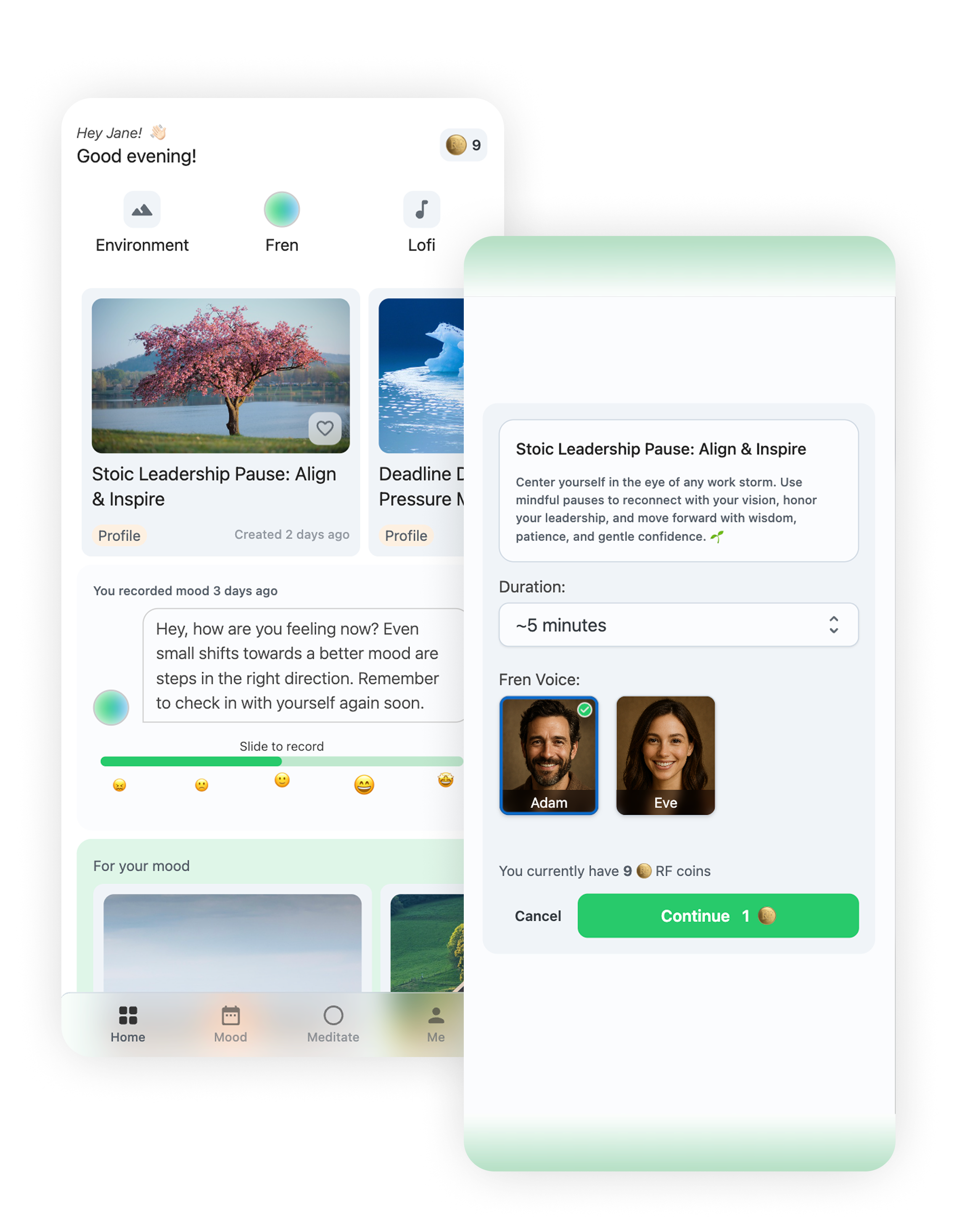
The challenge with nervous system regulation is that when you need it most — when you're stressed, overwhelmed, or anxious — it's hardest to remember what to do. This is where AI-powered meditation apps like RelaxFrens provide enormous value. By detecting your current stress state through your input and behavioral patterns, the app recommends the exact regulation technique your nervous system needs right now and guides you through it step by step.
For acute anxiety, it might recommend box breathing. For chronic stress, a body scan. For emotional numbness, a loving-kindness practice. The intelligence lies in the personalization, not just the content.
Frequently Asked Questions
What does it mean to regulate your nervous system?
Nervous system regulation means shifting from a stressed, activated state (sympathetic) to a calm, restorative state (parasympathetic). A regulated nervous system can move fluidly between activation when needed and rest when appropriate, without getting stuck in chronic stress or shutdown.
How do I know if my nervous system is dysregulated?
Signs of dysregulation include chronic anxiety, difficulty sleeping, digestive problems, chronic fatigue, emotional volatility, hypervigilance, difficulty concentrating, chronic pain, and feeling constantly on edge or, conversely, emotionally numb and disconnected.
How long does it take to regulate the nervous system?
Acute regulation (calming a stress response) can happen in 2–10 minutes with breathwork or grounding. Lasting change in your baseline nervous system tone typically takes 6–12 weeks of consistent practice.
Build a Regulated Nervous System with RelaxFrens
RelaxFrens personalizes every session to your current nervous system state — delivering the exact technique you need for calm, connection, and resilience.
Conclusion
Nervous system regulation is not a niche concept — it is the foundation of mental health. When your nervous system can move fluidly between activation and rest, anxiety dissolves, sleep improves, relationships deepen, and clarity returns. The techniques in this guide — breathwork, cold exposure, somatic movement, mindfulness, and social connection — are all supported by substantial evidence.
For related topics, explore our guides on vagus nerve exercises and somatic exercises for stress relief to deepen your regulation toolkit. For why a matched session can downshift faster than a generic track, see personalized vs generic meditation apps. And try RelaxFrens to bring intelligent personalization to your daily practice.
If this was useful, pass it along to someone who might need it.
Start a personalised meditation practice
An AI meditation app that builds customised sessions for your mood, stress, and sleep.
Ready to try a personalised meditation app?
RelaxFrens is an AI meditation app that creates customised sessions for your mood, stress, and sleep — not a fixed catalogue of the same tracks.
30-day money-back guarantee · Cancel anytime