Self-Compassion Meditation: How to Stop Being Your Own Worst Critic
The research is clear: self-compassion is the foundation of resilience, not weakness. Discover how to cultivate it through proven meditation practices.
By RelaxFrens Team
June 23, 2026
13 min read
You would never speak to a good friend the way you speak to yourself. If a friend told you they made a mistake, you wouldn't say "You're so stupid. You always mess things up. You're going to fail." Yet this is precisely the running commentary that most people maintain about themselves — constantly, automatically, and without question.
Self-compassion meditation is the practice of interrupting that commentary and replacing it with the same warmth and understanding you would offer someone you care about. Researcher Kristin Neff has spent two decades documenting the effects: measurably lower anxiety, less depression, greater resilience, higher motivation, and better relationships. Combined with AI-guided meditation, this practice is more accessible than ever in 2026. For the closely related practice of addressing imposter syndrome, see our guide on overcoming imposter syndrome with loving-kindness meditation.
The Three Components of Self-Compassion
Kristin Neff's research identified three interdependent components that together constitute genuine self-compassion:
Self-Kindness (vs. Self-Judgment)
Treating yourself with warmth and understanding in the face of failure, rather than harsh self-criticism. Acknowledging that imperfection is part of being human, not evidence of your unworthiness.
Common Humanity (vs. Isolation)
Recognizing that suffering, inadequacy, and failure are universal human experiences — not signs that something is uniquely wrong with you. You are not alone in struggling.
Mindfulness (vs. Over-Identification)
Holding painful feelings in balanced awareness rather than suppressing them or drowning in them. You can observe "I am experiencing self-criticism right now" without becoming fused with it.
What the Research Shows
Self-compassion predicts greater emotional resilience after failure and setbacks
Higher self-compassion is associated with lower anxiety, depression, and stress
Self-compassionate people have higher intrinsic motivation and take more responsibility for mistakes
Self-compassion reduces the fear of failure that causes performance paralysis
Partners of self-compassionate people report higher relationship satisfaction
Self-compassion training reduces perfectionism without reducing standards or ambition
5 Self-Compassion Meditation Practices
The Self-Compassion Break (5 minutes)
When you notice you're suffering or self-critical, pause and run through three steps: 1) Acknowledge: 'This is a moment of suffering.' 2) Connect: 'Suffering is part of life. I'm not alone in this.' 3) Offer kindness: Place hands on heart and say, 'May I be kind to myself. May I give myself what I need.' This brief practice interrupts the inner-critic spiral immediately.
Practice: Anytime you notice self-criticism or difficulty. Takes 2–5 minutes.
Loving-Kindness for Yourself (Metta)
Sit comfortably and silently repeat these phrases: 'May I be happy. May I be healthy. May I be safe. May I live with ease.' Each phrase is a wish, not an affirmation. Start with yourself, then gradually extend to loved ones, neutral people, difficult people, and all beings. Many people find the self-directed phrases the hardest — which is itself revealing.
Practice: 10–15 minutes daily. Especially powerful when combined with visualization.
The Good Friend Letter
Write a letter to yourself about a difficulty or perceived failure — from the perspective of a wise, compassionate, unconditionally accepting good friend who knows your situation fully. What would they say? What would they understand that you don't give yourself credit for? This written practice externalizes compassion in a way that often bypasses the defenses against self-directed kindness.
Practice: 15–20 minutes writing. Powerful for processing shame, failure, and self-judgment.
Compassionate Body Scan
Lie down and slowly scan your body from feet to head. When you encounter areas of tension, pain, or discomfort, rather than trying to relax them, simply offer them compassion: 'I see you. I know you're carrying something difficult. I'm here with you.' This radical acceptance of physical tension often releases it more effectively than direct relaxation effort.
Practice: 15–20 minutes. Particularly effective for stress-related physical symptoms.
Inner Critic Dialogue Practice
Set up two chairs facing each other. Sit in one and give voice to your inner critic — say aloud what it typically says to you. Then switch chairs and speak as your compassionate self responding to the critic. What does wisdom, kindness, and clarity say back? This externalizing technique, used in Gestalt therapy, makes the inner critic explicit and allows the compassionate self to develop a stronger voice.
Practice: 10–15 minutes. Powerful but emotionally activating — go gently.
Common Resistances to Self-Compassion
Belief: "Self-compassion will make me lazy and lower my standards."
Research shows the opposite: self-compassionate people are more motivated, not less, because they can try and fail without catastrophic self-punishment. Harsh self-criticism, paradoxically, reduces motivation by making failure too costly to risk.
Belief: "I don't deserve compassion — I actually did mess up."
Self-compassion is not about pretending you didn't make mistakes. It's about recognizing that making mistakes is human, processing them with clarity rather than shame, and moving forward. Shame is not a useful learning tool — it is a paralysis tool.
Belief: "This feels selfish."
You cannot pour from an empty cup. Self-compassion is what allows you to sustain compassion for others without burning out. The most empathic and effective helpers have high self-compassion — it is the foundation, not the enemy, of care for others.
Frequently Asked Questions
What is self-compassion meditation?
Self-compassion meditation cultivates kindness, warmth, and understanding toward yourself — especially during moments of failure or suffering. It uses three components: self-kindness, common humanity, and mindfulness. Based on Kristin Neff's research at UT Austin.
Is self-compassion the same as self-pity or weakness?
No. Research consistently shows self-compassion is associated with greater resilience, higher motivation, and better performance — not lower standards. It allows you to acknowledge failure without catastrophizing and learn from mistakes without self-punishment.
Can self-compassion meditation help with depression?
Yes. Self-compassion addresses one of depression's central mechanisms: harsh self-criticism. Compassion-Focused Therapy (CFT) is an evidence-based clinical approach built on this foundation. Always work with a professional for clinical depression.
Cultivate Self-Compassion with RelaxFrens
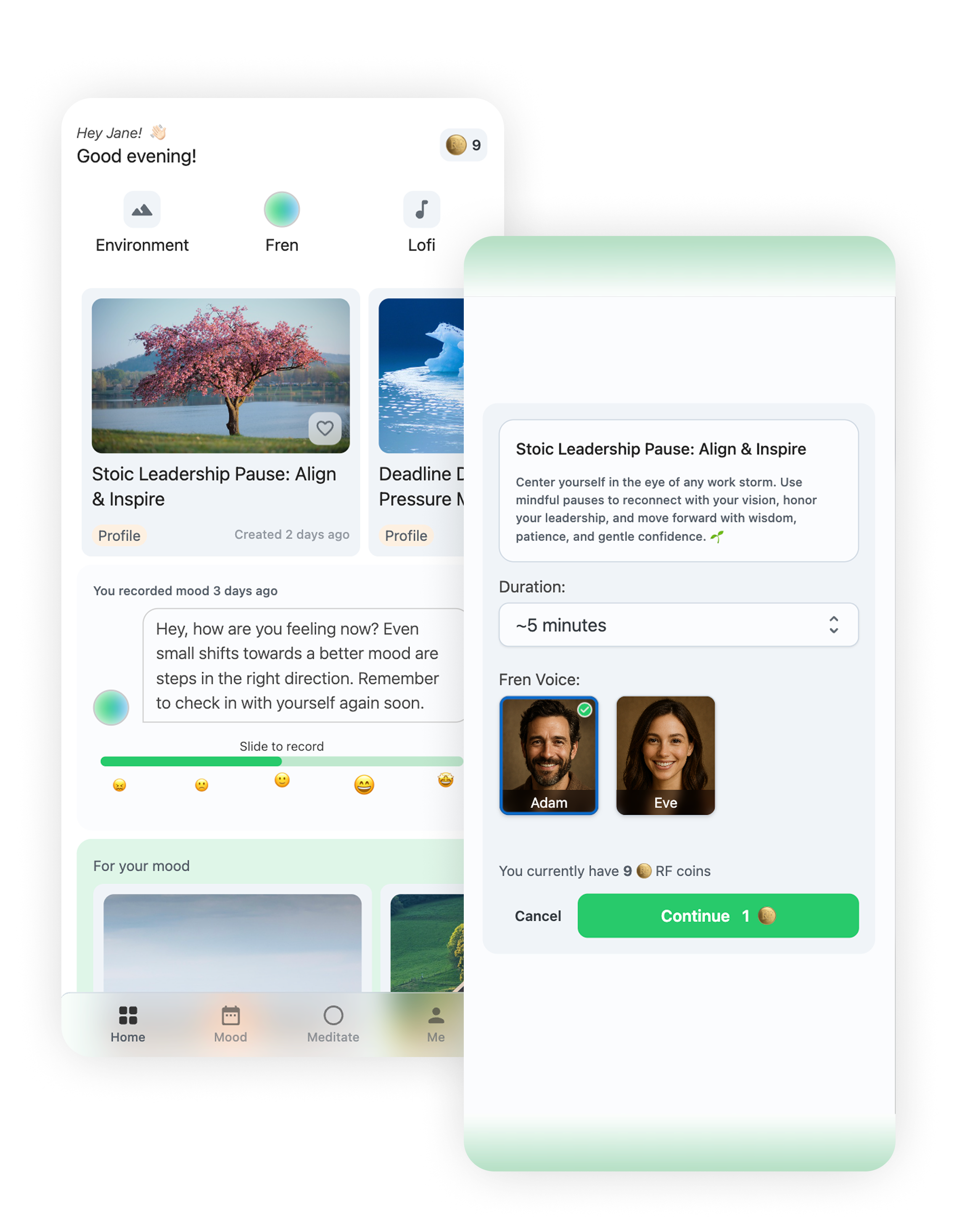
RelaxFrens offers personalized loving-kindness and self-compassion meditations that adapt to your emotional state — delivering the exact practice your inner critic needs to soften.
Conclusion
The inner critic convinces you that its harsh voice is the only thing standing between you and complacency. The research tells a completely different story: self-compassion produces better outcomes, greater resilience, higher motivation, and more meaningful relationships than self-criticism ever has.
Start with the Self-Compassion Break today — it takes five minutes and requires nothing except your willingness to speak to yourself with the same kindness you would offer a good friend. For a related practice, explore meditation for beginners to build the mindfulness foundation that self-compassion rests on.
If this was useful, pass it along to someone who might need it.

Start a personalised meditation practice
An AI meditation app that builds customised sessions for your mood, stress, and sleep.
Ready to try a personalised meditation app?
RelaxFrens is an AI meditation app that creates customised sessions for your mood, stress, and sleep — not a fixed catalogue of the same tracks.
30-day money-back guarantee · Cancel anytime