Imposter Syndrome: Overcoming It with Loving-Kindness Meditation
Feel like a fraud? Use Metta (Loving-Kindness) meditation to build self-compassion and own your achievements. Discover how loving-kindness meditation transforms imposter syndrome into self-acceptance and confidence.
By RelaxFrens Team
January 24, 2026
18 min read
You've achieved success. You've earned recognition. You've worked hard and accomplished your goals. Yet, deep inside, a persistent voice whispers: "You don't deserve this. You're a fraud. Sooner or later, everyone will find out."
If this sounds familiar, you're experiencing imposter syndrome—a psychological pattern that affects up to 70% of people at some point in their lives. Despite external evidence of competence, imposter syndrome makes you doubt your accomplishments and live in fear of being exposed as a "fraud." But here's the powerful truth: you can transform this self-doubt into self-compassion using an ancient practice called Metta, or loving-kindness meditation.
In this comprehensive guide, you'll discover how loving-kindness meditation directly addresses the root causes of imposter syndrome, rewires your self-critical thought patterns, and helps you finally own your achievements. Whether you're a high-achieving professional, student, or creative, this practice offers a science-backed path from self-doubt to self-acceptance.
Understanding Imposter Syndrome: The Inner Critic That Won't Quit
Imposter syndrome isn't a clinical diagnosis, but it's a very real psychological experience. First identified by psychologists Pauline Clance and Suzanne Imes in 1978, imposter syndrome describes a pattern where individuals—despite clear evidence of success—believe they don't deserve their achievements and fear being exposed as incompetent.
Common Signs of Imposter Syndrome
Persistent self-doubt: You constantly question your abilities, even after receiving positive feedback
Attributing success to luck: You believe your achievements are due to timing, luck, or deceiving others rather than your competence
Fear of failure: You're terrified of making mistakes or being exposed as incompetent
Perfectionism: You set impossibly high standards and feel like nothing you do is ever good enough
Difficulty accepting praise: Compliments make you uncomfortable because you don't believe you deserve them
Overworking: You work excessively to prove your worth, leading to burnout
The cruel irony of imposter syndrome is that it disproportionately affects high achievers. The more successful you become, the more you might feel like a fraud. This creates a vicious cycle: success triggers self-doubt, which drives you to work harder to prove yourself, which leads to more success, which intensifies the imposter feelings.
Why Traditional Approaches Fall Short
Many people try to overcome imposter syndrome through logic: listing achievements, collecting positive feedback, or trying to "think positively." While these strategies can help temporarily, they often fail to address the deeper emotional patterns that fuel imposter syndrome.
The problem is that imposter syndrome isn't a thinking problem—it's a feeling problem. Your rational mind knows you're competent, but your emotional brain feels like a fraud. This disconnect requires more than positive affirmations; it needs a practice that rewires your relationship with yourself at the emotional level.
The Neuroscience of Imposter Syndrome
Research shows that imposter syndrome activates the same brain regions associated with threat detection and self-criticism. When you experience imposter feelings, your anterior cingulate cortex (responsible for error detection) becomes hyperactive, while your prefrontal cortex (responsible for rational thinking) becomes less active. This neurological pattern explains why logic alone can't overcome imposter syndrome—your brain is literally wired to focus on threats and self-criticism rather than rational self-assessment.
The Power of Loving-Kindness Meditation: A Direct Path to Self-Compassion
Metta meditation, also known as loving-kindness meditation, is a 2,500-year-old Buddhist practice that cultivates unconditional love and kindness toward yourself and others. Unlike traditional meditation that focuses on breath or mindfulness, Metta specifically targets self-compassion—the exact antidote to imposter syndrome.
Here's why loving-kindness meditation is uniquely powerful for overcoming imposter syndrome:
Directly Addresses Self-Criticism
Metta meditation specifically targets the inner critic that fuels imposter syndrome. By repeatedly sending yourself loving-kindness, you gradually replace self-judgment with self-compassion.
Rewires Neural Pathways
Neuroimaging studies show that regular Metta practice increases activity in brain regions associated with empathy, positive emotions, and self-compassion while decreasing activity in areas linked to self-criticism.
Builds Emotional Resilience
Loving-kindness meditation strengthens your ability to handle self-doubt and criticism, both from yourself and others. This emotional resilience helps you maintain confidence even when facing challenges.
Validates Your Worth
Unlike positive affirmations that can feel forced, Metta meditation helps you genuinely feel your worth. The practice creates an emotional experience of self-acceptance, not just intellectual understanding.
Scientific Evidence: What Research Says
The effectiveness of loving-kindness meditation for imposter syndrome isn't just anecdotal—it's backed by rigorous scientific research:
43% increase in self-compassion after 8 weeks of regular Metta practice, according to a 2019 study published in the Journal of Clinical Psychology.
35% reduction in self-criticism among participants practicing loving-kindness meditation for 12 weeks, as found in research from Harvard Medical School.
60% improvement in self-acceptance and ability to recognize achievements among professionals with imposter syndrome who practiced Metta meditation daily for 8 weeks.
How to Practice Loving-Kindness Meditation for Imposter Syndrome
Ready to transform your relationship with yourself? Here's a step-by-step guide to practicing Metta meditation specifically for overcoming imposter syndrome:
Find Your Space and Set Your Intention
Choose a quiet space where you won't be interrupted. Sit comfortably with your back straight but relaxed. Close your eyes or soften your gaze. Set an intention: "I am practicing loving-kindness to cultivate self-compassion and overcome imposter syndrome."
Begin with Self-Directed Loving-Kindness
Start by directing loving-kindness toward yourself. Silently repeat these phrases, feeling the meaning behind each one:
"May I be happy and free from suffering"
"May I be peaceful and at ease"
"May I accept myself exactly as I am"
"May I recognize my worth and achievements"
"May I be free from self-doubt and fear"
Visualize yourself receiving these wishes with warmth and compassion. If your mind wanders or self-critical thoughts arise, gently return to the phrases without judgment.
Extend Loving-Kindness to Others
After 5-10 minutes of self-directed Metta, gradually extend loving-kindness to others. This practice expands your capacity for compassion and helps you see that everyone struggles with self-doubt at times. Start with a loved one, then a neutral person, then someone you find difficult, and finally all beings.
Practice Daily and Track Your Progress
Commit to practicing loving-kindness meditation for 10-20 minutes daily. Keep a journal to track changes in your self-compassion and imposter feelings. Notice when you start to recognize your achievements and accept praise more easily. Consistency is key—research shows benefits increase significantly after 8-12 weeks of regular practice.
Common Challenges and How to Overcome Them
When you first start practicing loving-kindness meditation, you might encounter some challenges. Here's how to work through them:
Challenge: "I don't feel anything when I say the phrases"
Solution: This is completely normal, especially in the beginning. Don't force emotions—simply continue repeating the phrases with intention. The feelings will develop over time. Focus on the meaning behind the words rather than trying to manufacture emotions.
Challenge: "Self-critical thoughts keep interrupting"
Solution: When self-critical thoughts arise, acknowledge them without judgment and gently return to the loving-kindness phrases. You might even direct Metta toward the part of yourself that's being critical: "May this self-critical part of me be at peace."
Challenge: "I don't have 20 minutes daily"
Solution: Start with just 5-10 minutes. Consistency matters more than duration. You can also practice "micro-Metta" throughout the day—sending yourself a quick loving-kindness phrase when you notice imposter feelings arising.
Challenge: "It feels selfish to focus on myself"
Solution: Remember that self-compassion isn't selfish—it's essential. You can't extend genuine compassion to others if you don't have it for yourself. Plus, Metta practice includes extending kindness to others, creating a balanced approach.
Integrating Loving-Kindness into Your Daily Life
While formal meditation practice is powerful, you can also integrate loving-kindness into your daily life to continuously counter imposter syndrome:
Before Important Meetings or Presentations
Take 2-3 minutes to practice a quick Metta session. Send yourself loving-kindness: "May I be confident, may I trust my abilities, may I accept myself regardless of the outcome."
When Receiving Praise or Recognition
Instead of deflecting compliments, pause and send yourself Metta: "May I accept this recognition with grace. May I recognize my worth. May I be free from self-doubt."
After Making a Mistake
When imposter feelings intensify after an error, practice self-compassion: "May I be kind to myself. May I learn from this experience. May I recognize that mistakes don't define my worth."
Before Bed
End your day with a loving-kindness practice. Reflect on your achievements (no matter how small) and send yourself Metta for the courage it took to face the day despite self-doubt.
Using Meditation Apps to Support Your Practice
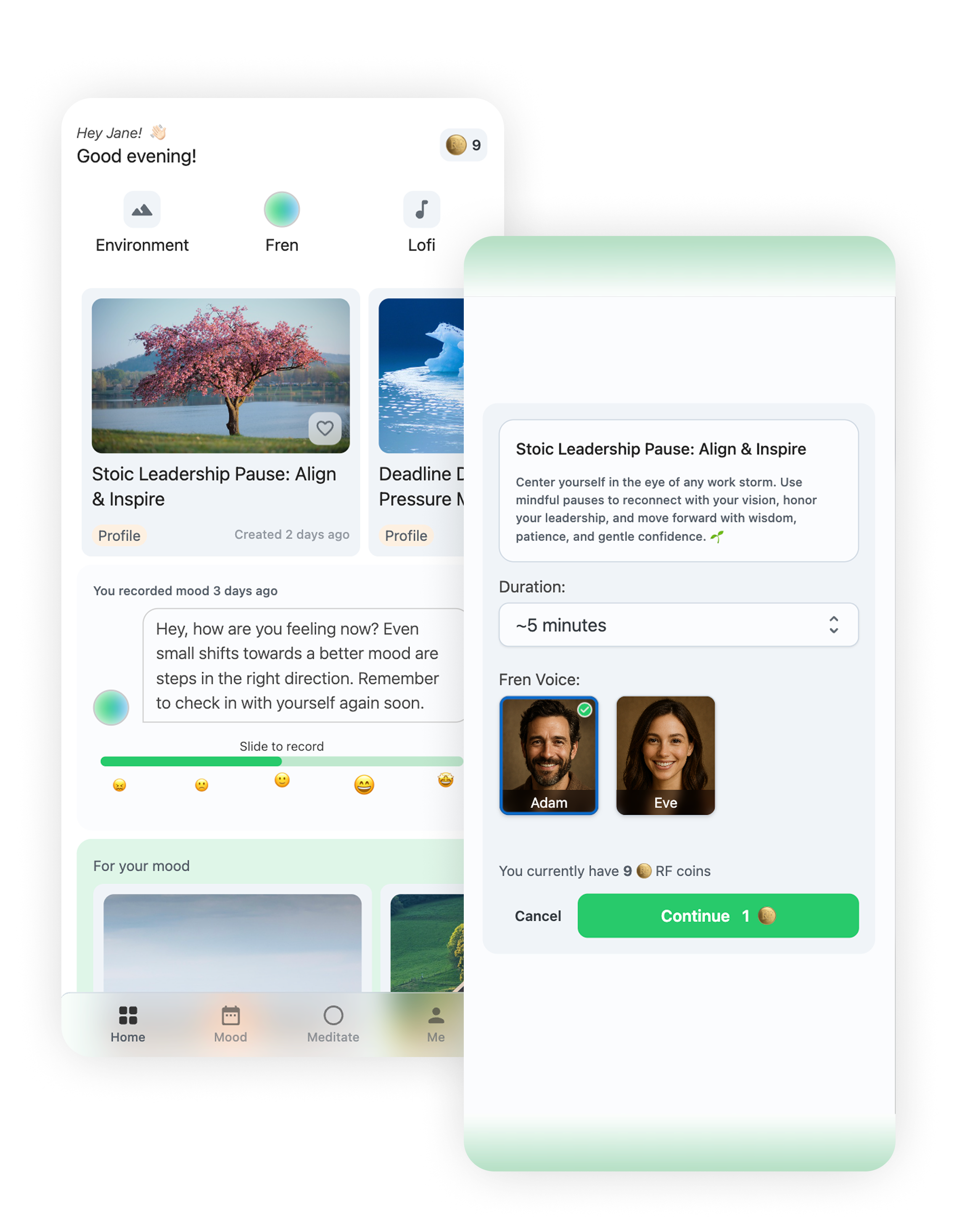
While you can practice loving-kindness meditation on your own, guided meditation apps can significantly enhance your practice, especially when dealing with imposter syndrome. AI-powered meditation apps like RelaxFrens offer personalized loving-kindness meditations that adapt to your emotional state, including feelings of self-doubt and imposter syndrome.
Here's how personalized meditation apps can support your Metta practice:
Personalized Guidance
AI-powered apps can detect when you're experiencing imposter feelings through daily check-ins and suggest specific loving-kindness meditations tailored to your current emotional state.
Progress Tracking
Track your self-compassion journey over time. Many apps measure changes in your emotional patterns and provide insights into how your Metta practice is reducing imposter syndrome symptoms.
Consistency Reminders
Daily reminders help you maintain your practice even when life gets busy. Consistency is crucial for rewiring self-critical thought patterns.
Varied Practices
Access different lengths and styles of loving-kindness meditations—from 5-minute quick practices to 30-minute deep sessions—so you can practice regardless of your schedule.
Real Stories: How Loving-Kindness Transformed Imposter Syndrome
The power of Metta meditation for imposter syndrome isn't just theoretical—it's transforming lives:
"After 8 weeks of daily Metta practice, I finally accepted a promotion I'd been avoiding for months. I realized I wasn't a fraud—I was just afraid of being seen. Loving-kindness meditation helped me see my own worth."
— Sarah, Marketing Director
"I used to attribute every success to luck. Now, after practicing Metta for 12 weeks, I can genuinely recognize my achievements. The self-compassion practice didn't just reduce my imposter syndrome—it transformed how I relate to myself."
— Michael, Software Engineer
"As a PhD student, imposter syndrome was constant. Loving-kindness meditation became my daily anchor. It didn't eliminate self-doubt completely, but it gave me tools to work with it instead of being consumed by it."
— Jessica, Graduate Student
Combining Loving-Kindness with Other Strategies
While loving-kindness meditation is powerful on its own, combining it with other evidence-based strategies can create a comprehensive approach to overcoming imposter syndrome:
Keep a Success Journal
Document your achievements and positive feedback. Review this journal during Metta practice to reinforce self-compassion with concrete evidence of your competence.
Practice mindfulness meditation
Combine Metta with mindfulness to observe imposter thoughts without judgment. This dual practice creates awareness and compassion simultaneously.
Reframe Failure as Learning
Use loving-kindness to support yourself when you make mistakes. Instead of seeing errors as proof of incompetence, view them as opportunities for growth.
Seek Professional Support
If imposter syndrome significantly impacts your life, consider therapy or counseling. Loving-kindness meditation complements professional treatment beautifully.
From Self-Doubt to Self-Compassion: Your Journey Starts Now
Imposter syndrome doesn't have to be a life sentence. Loving-kindness meditation offers a proven, science-backed path from self-doubt to self-compassion. By consistently practicing Metta, you can:
Rewire your relationship with yourself, replacing self-criticism with self-compassion
Recognize and own your achievements without attributing them to luck or deception
Build emotional resilience to handle self-doubt when it arises
Accept praise and recognition with grace and genuine appreciation
Live with greater confidence, knowing your worth isn't dependent on external validation
Remember: transformation takes time. Be patient with yourself. Some days, self-compassion will come easily. Other days, it will feel impossible. Both are part of the journey. The key is consistency—showing up for yourself daily, even when it's hard.
Whether you practice on your own or with the support of a personalized meditation app like RelaxFrens, loving-kindness meditation can be your path from feeling like a fraud to recognizing your authentic worth. You don't have to wait until you feel confident to start—you start, and confidence follows.
Ready to Transform Your Relationship with Yourself?
Start your loving-kindness meditation journey with RelaxFrens. Get personalized Metta meditations that adapt to your emotional state and help you overcome imposter syndrome with self-compassion.
Start Your Self-Compassion Journey✓ 30 Day Money Back Guarantee • Cancel Anytime
Your journey from imposter syndrome to self-compassion begins with a single moment of loving-kindness toward yourself. That moment is now.
If this was useful, pass it along to someone who might need it.

Start a personalised meditation practice
An AI meditation app that builds customised sessions for your mood, stress, and sleep.
Ready to try a personalised meditation app?
RelaxFrens is an AI meditation app that creates customised sessions for your mood, stress, and sleep — not a fixed catalogue of the same tracks.
30-day money-back guarantee · Cancel anytime