Meditation for Anxiety: 7 Science-Backed Techniques That Actually Work (2026 Guide)
Evidence-based meditation methods to calm your anxious mind, reduce panic, and find lasting relief — backed by neuroscience and clinical research.
By RelaxFrens Team
June 26, 2026
14 min read
Anxiety affects over 284 million people worldwide, making it the most common mental health disorder on the planet. Yet one of the most powerful tools for managing it — meditation — remains underused because most people don't know which technique to use or how to start when their mind is racing.
This guide cuts through the noise. Every technique below has been validated by peer-reviewed research, and each one targets the specific neurological mechanisms that drive anxiety. Whether you're managing everyday worry, social anxiety, or panic attacks, you'll find a method that works — and learn how AI-powered anxiety relief tools are making these practices more effective than ever in 2026.
Why Meditation Works for Anxiety: The Neuroscience
Anxiety lives in the amygdala — the brain's threat-detection center. When you're anxious, the amygdala fires repeatedly, keeping you in a low-grade fight-or-flight state. Meditation directly counters this through four proven mechanisms:
Amygdala Shrinkage
An 8-week MBSR program reduced amygdala gray matter density in stressed adults (Harvard, 2011), meaning your brain's alarm system becomes physically less reactive.
Prefrontal Cortex Strengthening
Meditation thickens the prefrontal cortex — the rational brain — giving it more regulatory power over the amygdala so you can observe anxious thoughts without being hijacked by them.
Cortisol Reduction
Mindfulness meditation measurably lowers salivary cortisol levels, reducing the hormonal fuel that keeps anxiety burning throughout the day.
Parasympathetic Activation
Slow, controlled breathing stimulates the vagus nerve, switching your nervous system from sympathetic (fight-or-flight) to parasympathetic (rest-and-digest). Learn more in our nervous system regulation guide.
7 Science-Backed Meditation Techniques for Anxiety
Each technique addresses anxiety differently. Try several to find what resonates with your nervous system.
Mindfulness Breath Awareness
The gold-standard in Mindfulness-Based Stress Reduction (MBSR). Sit comfortably, close your eyes, and place full attention on the physical sensations of breathing. When anxious thoughts arise, label them 'thinking' and return to the breath without judgment. Reduces generalized anxiety disorder symptoms by up to 58% in clinical trials.
Practice: 10 minutes daily.
4-7-8 Breathing (Relaxation Breath)
Inhale through your nose for 4 counts, hold for 7 counts, exhale through your mouth for 8 counts. The extended exhale maximally activates the vagus nerve and triggers the parasympathetic response. Works in under 60 seconds.
Practice: 4 cycles, twice daily or during acute anxiety.
Body Scan Meditation
Anxiety manifests physically — tight chest, clenched jaw, knotted stomach. The body scan systematically moves attention from feet to head, noticing sensations without judgment. This breaks the feedback loop where mental anxiety amplifies physical tension.
Practice: 20 minutes full session or 5-minute express version.
Loving-Kindness (Metta) Meditation
Anxiety often includes a harsh inner critic. Loving-kindness counters this by cultivating self-compassion. Silently repeat: 'May I be safe. May I be healthy. May I be happy. May I live with ease.' Then extend these wishes to others. Measurably reduces social anxiety and self-criticism.
Practice: 10–15 minutes. Especially effective for social anxiety.
Box Breathing (4-4-4-4)
Used by US Navy SEALs before high-stress operations. Inhale for 4 counts, hold for 4, exhale for 4, hold for 4. This symmetric pattern rapidly calms the nervous system. One of the most effective tools for acute anxiety and panic episodes.
Practice: 4–6 cycles. Works in under 2 minutes. Read our full box breathing guide.
5-4-3-2-1 Grounding Meditation
When anxiety pulls you into future-catastrophizing, grounding anchors you in the present. Name 5 things you can see, 4 you can physically feel, 3 you can hear, 2 you can smell, and 1 you can taste. This sensory exercise overrides the brain's threat-scanning mode.
Practice: Anytime, anywhere. No setup. Takes 2–3 minutes.
AI-Personalized Adaptive Meditation
The newest and most effective format in 2026. AI-powered apps analyze your current emotional state, recent stress patterns, and preferences to generate a session calibrated to what your nervous system needs right now — no guessing required.
Practice: Daily, as little as 5 minutes. Highest adherence rate of any format.
How to Start When You're Too Anxious to Meditate
The bitter irony: anxiety makes the stillness of meditation feel impossible. Here's how to break through:
Start with movement, not stillness
If sitting feels impossible, try a walking meditation first. The rhythmic movement gives your nervous system a physical anchor and burns off some anxious energy before you sit.
Use 3 minutes, not 20
Severely anxious minds cannot sustain long sessions. Start with just 3 minutes of box breathing or 5-4-3-2-1 grounding. Success with short sessions builds confidence and gradually extends your capacity.
Open your eyes
Closing your eyes with anxiety can feel claustrophobic. Soft-gazing at a fixed point on the floor — eyes open but unfocused — provides the same concentration anchor without the trapped feeling.
Let an AI guide you
AI-powered anxiety relief apps can detect when you're struggling and adjust the pacing in real time, removing decision fatigue when your mind is most scattered.
A Simple Daily Anxiety-Reduction Routine
Morning (5–10 min): Mindfulness breath awareness
Sets a calm, intentional tone before the day's stressors arrive. Best done before checking your phone.
Midday (2 min): Box breathing or 4-7-8 breath
Use before high-stakes meetings, difficult conversations, or whenever you feel tension building.
Evening (10–15 min): Body scan or loving-kindness
Processes the day's accumulated tension and primes your nervous system for sleep.
As-needed: 5-4-3-2-1 grounding
Deploy any time anxiety spikes — in public, before presentations, during conflict. No setup required.
Meditation complements, not replaces, professional care
For clinical anxiety disorders (GAD, panic disorder, PTSD, OCD), meditation works best alongside professional therapy — particularly CBT or ACT. If your anxiety significantly impairs daily functioning, please consult a licensed mental health professional.
Frequently Asked Questions
Can meditation really help with anxiety?
Yes — strongly. Multiple peer-reviewed meta-analyses confirm mindfulness meditation produces moderate-to-large reductions in anxiety symptoms. The JAMA Internal Medicine meta-analysis (2014, 47 trials) found mindfulness programs led to significant improvements in anxiety and depression. Regular practice physically reshapes the amygdala over 8 weeks.
How long does it take to feel results?
Most people feel calmer within a single session. Lasting structural brain changes occur after 8 weeks of consistent daily practice (10–15 min/day). The immediate physiological effect of slow breathing starts working in under 60 seconds.
Can I meditate during a panic attack?
During a panic attack, box breathing and the 5-4-3-2-1 grounding technique are most accessible. These activate the parasympathetic response quickly. Regular meditation between panic attacks reduces their frequency and intensity over time.
Start Calming Anxiety Today
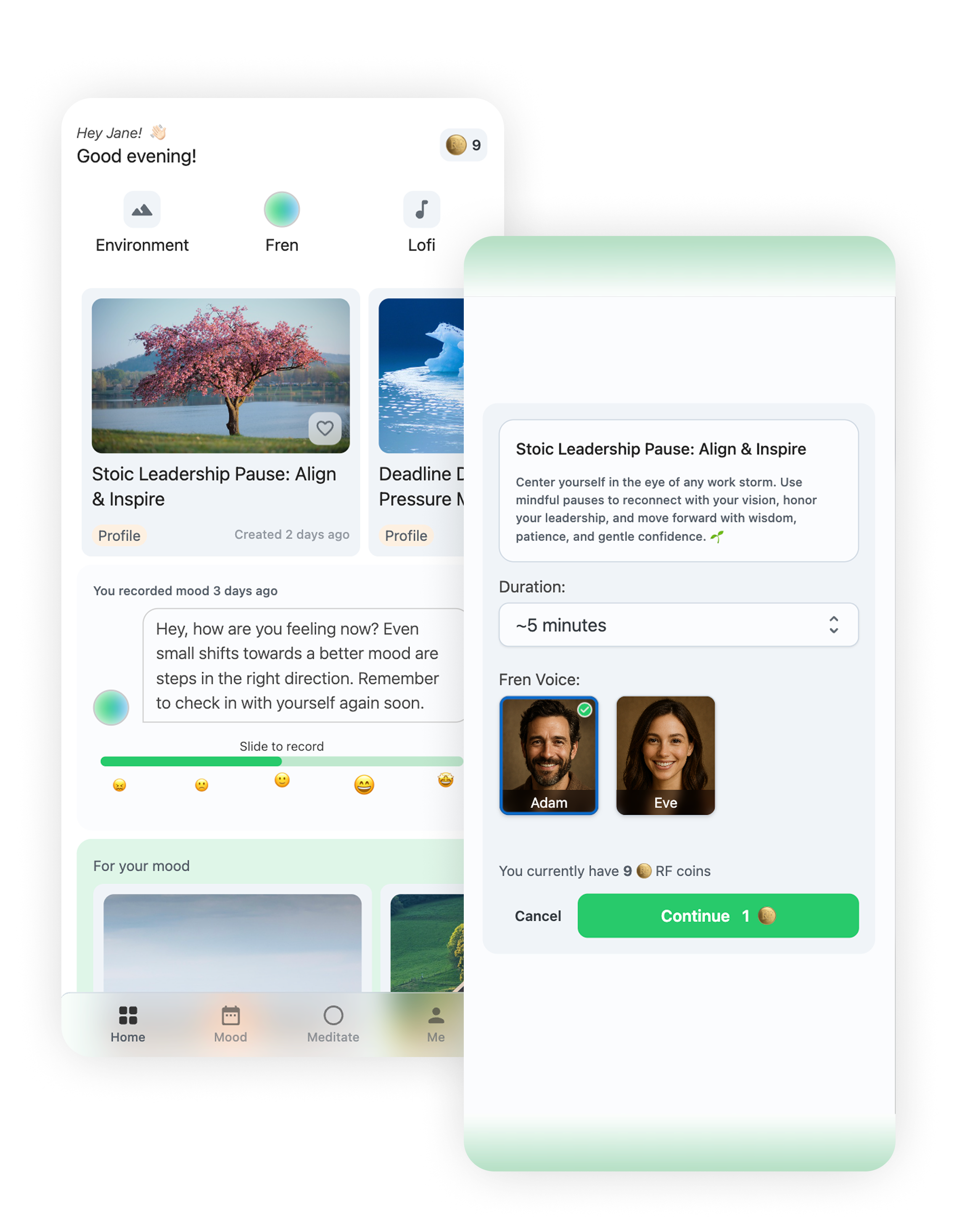
RelaxFrens uses AI to detect your current anxiety level and generate a personalized meditation session — the right technique, the right duration, at the right moment.
Conclusion
Meditation for anxiety is not a soft alternative — it's a clinically validated intervention that changes your brain. The seven techniques in this guide range from 60-second breathing exercises to immersive body scans, covering every anxiety scenario from mild daily stress to acute panic.
Start with whichever technique feels most approachable, practice it daily for two weeks, and notice the difference. For the most efficient path forward, an AI-powered meditation app takes the guesswork out entirely. To understand why breathing works so powerfully on anxiety, read our full guide to nervous system regulation. If constant notifications are feeding the anxiety, pair this with meditation for digital detox.
If this was useful, pass it along to someone who might need it.

Start a personalised meditation practice
An AI meditation app that builds customised sessions for your mood, stress, and sleep.
Ready to try a personalised meditation app?
RelaxFrens is an AI meditation app that creates customised sessions for your mood, stress, and sleep — not a fixed catalogue of the same tracks.
30-day money-back guarantee · Cancel anytime