Meditation for Focus: Techniques That Help You Stay in Flow
Discover ADHD-friendly meditation techniques, focus sounds, and productivity strategies to help you enter and maintain flow state. Learn how meditation enhances concentration, reduces distractions, and boosts work performance.
By RelaxFrens Team
January 30, 2026
14 min read
You sit down to work, but your mind jumps between tasks. You check your phone, remember an email you need to send, then get distracted by a notification. Before you know it, an hour has passed and you've accomplished nothing meaningful. Sound familiar? You're not alone—the average person loses 2.5 hours per day to distractions, and for those with ADHD, this number can be even higher.
But here's the good news: meditation isn't just for relaxation. When practiced with intention, meditation becomes a powerful tool for enhancing focus, entering flow state, and dramatically improving productivity. Whether you have ADHD, struggle with distractions, or simply want to work more efficiently, meditation can help you train your brain to maintain deep focus.
The Science: How Meditation Trains Your Brain for Focus
Before diving into techniques, it's helpful to understand what's happening in your brain when you meditate for focus. Meditation doesn't just calm you—it actively rewires neural pathways associated with attention and concentration.
Enhanced Attention Networks
Meditation strengthens three key attention networks: the alerting network (staying ready), the orienting network (directing attention), and the executive control network (maintaining focus despite distractions). Research shows that just 8 weeks of daily meditation increases activity in the prefrontal cortex—the brain region responsible for sustained attention and decision-making.
Reduced Task-Switching
Multitasking is a productivity killer—switching between tasks can reduce efficiency by up to 40%. Meditation trains your brain to resist the urge to switch tasks, improving your ability to maintain single-task focus. Studies show that regular meditators have 22% less mind-wandering and can maintain focus for longer periods without mental fatigue.
Flow State Activation
Flow state—that magical zone where work feels effortless and time disappears—requires specific brain conditions: reduced activity in the prefrontal cortex (less self-consciousness), increased gamma wave activity (heightened awareness), and balanced dopamine levels. Meditation creates these exact conditions, making it easier to enter flow state during work or creative activities.
ADHD-Friendly Meditation Techniques: Working With Your Brain, Not Against It
Traditional meditation—sitting still with eyes closed for 20 minutes—can feel impossible for people with ADHD. But meditation doesn't have to mean stillness. These ADHD-friendly techniques work with your brain's natural tendencies rather than fighting them.
1. Movement-Based Meditation: Walking and Yoga
For ADHD brains, physical movement can actually enhance focus rather than distract from it. Movement-based meditation provides the physical stimulation your brain needs while training attention.
Walking Meditation Technique:
Start Small: Begin with 5-minute walking meditations. Walk at a natural pace, either indoors or outdoors.
Focus on Sensations: Pay attention to the feeling of your feet touching the ground, the rhythm of your steps, the movement of your legs. When your mind wanders (it will), gently return to these physical sensations.
Use a Mantra: Sync a simple phrase with your steps: “Here, now” or “Step, breathe.” This gives your mind something to anchor to.
Build Gradually: Increase duration as it becomes easier. Many people with ADHD find 15-20 minute walking meditations more accessible than seated ones.
Why It Works for ADHD: Walking provides the physical stimulation ADHD brains crave while the structured focus on sensations prevents restlessness. The movement helps regulate dopamine and norepinephrine, neurotransmitters that are often imbalanced in ADHD.
2. Short, Structured Sessions: The 2-5 Minute Rule
Long meditation sessions can feel overwhelming for ADHD brains. Short, frequent sessions are more effective and sustainable.
Start with 2 Minutes
Set a timer for exactly 2 minutes. This eliminates the mental resistance that comes with longer commitments. You can always do another 2-minute session later if you want.
Use Guided Meditations
Guided meditations provide external structure that ADHD brains need. The voice gives you something to focus on and brings you back when your mind wanders. Apps like RelaxFrens offer personalized guided sessions that adapt to your attention patterns.
Multiple Sessions Per Day
Instead of one 20-minute session, try three 5-minute sessions throughout the day. This approach works better for ADHD attention patterns and provides more frequent focus training.
3. Body Scan Meditation: Grounding Through Sensation
Body scan meditation is particularly effective for ADHD because it provides a structured way to move attention through the body, preventing restlessness and training focus.
Body Scan Technique:
Start at Your Toes: Bring attention to your toes. Notice any sensations—tingling, warmth, pressure, or nothing at all. Hold attention there for 10-15 seconds.
Move Systematically: Slowly move attention up through your body: feet, ankles, calves, knees, thighs, hips, abdomen, chest, shoulders, arms, hands, neck, face, head.
No Judgment: If you feel nothing in an area, that's fine. If your mind wanders, gently return to where you were in the scan.
Complete the Circuit: Finish by bringing attention to your whole body at once, feeling the body as a unified field of sensation.
Duration: Start with 5 minutes, gradually increasing to 10-15 minutes as you build the practice. This technique is excellent for pre-work focus sessions.
Focus Sounds: Using Audio to Enhance Concentration
Sound can be a powerful tool for focus. The right audio environment can mask distractions, signal your brain to enter focus mode, and even enhance cognitive performance. Here's how to use focus sounds effectively.
Binaural Beats: Frequency Following Response
Binaural beats are created when two slightly different frequencies are played in each ear. Your brain perceives a third frequency (the difference), which can influence brainwave states.
Best Frequencies for Focus:
40 Hz Gamma Waves: Associated with heightened focus, problem-solving, and peak performance. Ideal for complex work requiring deep concentration.
Beta Waves (14-30 Hz): Normal waking consciousness, alertness, and active thinking. Good for analytical work and tasks requiring mental clarity.
Alpha Waves (8-13 Hz): Relaxed but alert state, ideal for creative work and entering flow state. Reduces anxiety while maintaining focus.
How to Use: Listen to binaural beats at 40-50% volume through headphones during meditation or work. Start with 10-15 minute sessions. Some people find them most effective when combined with nature sounds or ambient music.
Nature Sounds: The Biophilia Effect
Research shows that nature sounds—rain, ocean waves, forest ambience—reduce stress, improve cognitive performance, and enhance focus. This is called the biophilia effect: our brains are wired to respond positively to natural environments.
Rain Sounds
Steady rain creates a consistent audio backdrop that masks distracting noises. The rhythmic pattern helps regulate attention and reduces cortisol levels. Ideal for deep work sessions.
Ocean Waves
The ebb and flow of waves creates a natural rhythm that promotes relaxation while maintaining alertness. Studies show ocean sounds improve memory and cognitive performance.
Forest Ambience
Bird songs, rustling leaves, and gentle wind create a rich but non-distracting soundscape. Forest sounds have been shown to reduce stress by 37% and improve focus by 23%.
White Noise and Pink Noise: Masking Distractions
White noise (equal energy across all frequencies) and pink noise (more energy in lower frequencies) create a consistent audio environment that masks unpredictable sounds—conversations, traffic, notifications—that break focus.
When to Use Each:
White Noise: Best for blocking out sharp, unpredictable sounds (office chatter, construction). Use at moderate volume—too loud can be distracting.
Pink Noise: Softer and more natural-sounding than white noise. Better for extended work sessions and sleep. Some research suggests pink noise enhances deep sleep and memory consolidation.
Brown Noise: Even deeper frequencies, creates a rumbling sound like a waterfall. Excellent for people sensitive to higher frequencies. Very effective for ADHD focus.
Ambient Music: The Focus Playlist Strategy
Unlike songs with lyrics (which compete for attention), ambient music provides structure without distraction. The key is choosing music without sudden changes or attention-grabbing elements.
Lo-Fi Hip Hop
Steady beats, minimal lyrics, and consistent tempo make lo-fi ideal for focus. The repetitive nature helps maintain attention without being boring.
Classical Music (Baroque)
Research shows that Baroque music (Bach, Vivaldi) at 60 beats per minute can enhance learning and memory. The structured patterns support sustained attention.
Ambient Electronic
Artists like Brian Eno, Aphex Twin (ambient works), and Stars of the Lid create soundscapes designed for focus. These tracks are specifically engineered to support concentration.
The Productivity Angle: Meditation as a Performance Tool
Meditation isn't just about feeling calm—it's a performance enhancement tool. When integrated into your work routine, meditation can dramatically improve productivity, decision-making, and work quality.
Pre-Work Meditation: The 5-Minute Focus Reset
Starting your workday with 5 minutes of meditation creates a mental reset that improves focus for hours. This practice helps transition from the chaos of morning routines into a state of clear, intentional work. Research shows that a brief pre-work meditation can improve attention span by 16% and reduce task-switching by 22% throughout the day.
Pomodoro Meditation Breaks
Instead of scrolling social media during Pomodoro breaks, try a 2-minute meditation. This refreshes your attention without the cognitive drain of digital distraction. Studies show that meditation breaks are more restorative than passive breaks, leading to better performance in subsequent work sessions.
Decision-Making Enhancement
Meditation improves decision-making by reducing emotional reactivity and increasing access to the prefrontal cortex (rational thinking). Before important decisions or meetings, a 3-minute meditation can help you respond thoughtfully rather than react impulsively. This leads to better outcomes and reduced decision fatigue.
The Flow State Protocol: Entering Deep Work
Flow state is where peak productivity happens. Here's a meditation-based protocol to help you enter flow state more reliably:
Pre-Flow Meditation Sequence (10 minutes):
Minute 1-2: Breath Awareness - Focus on your breath to calm the nervous system and reduce stress hormones that interfere with flow.
Minute 3-5: Body Scan - Release physical tension that creates mental resistance. A relaxed body supports a focused mind.
Minute 6-8: Intention Setting - Clearly state what you want to accomplish. Visualize yourself working with ease and focus.
Minute 9-10: Transition - Slowly open your eyes and move directly into your work. Don't check your phone or get distracted—maintain the meditative state as you begin.
Pro Tip: Use focus sounds (binaural beats or nature sounds) during this sequence and continue them during work to maintain the flow state.
Ready to Enhance Your Focus?
Start your focus meditation practice with RelaxFrens. Get personalized meditation sessions, access to focus sounds, and tools designed to help you enter flow state and boost productivity.
Get Started with RelaxFrensHow RelaxFrens Supports Focus and Flow
Building a meditation practice for focus is easier with the right tools. RelaxFrens offers features specifically designed to enhance concentration and support flow state:
Focus Sounds Library
RelaxFrens includes a comprehensive library of focus sounds including binaural beats, nature sounds (rain, ocean, forest), white noise, and ambient music. These sounds are designed to enhance concentration during meditation and can be used during work sessions to maintain focus.
Personalized Focus Meditations
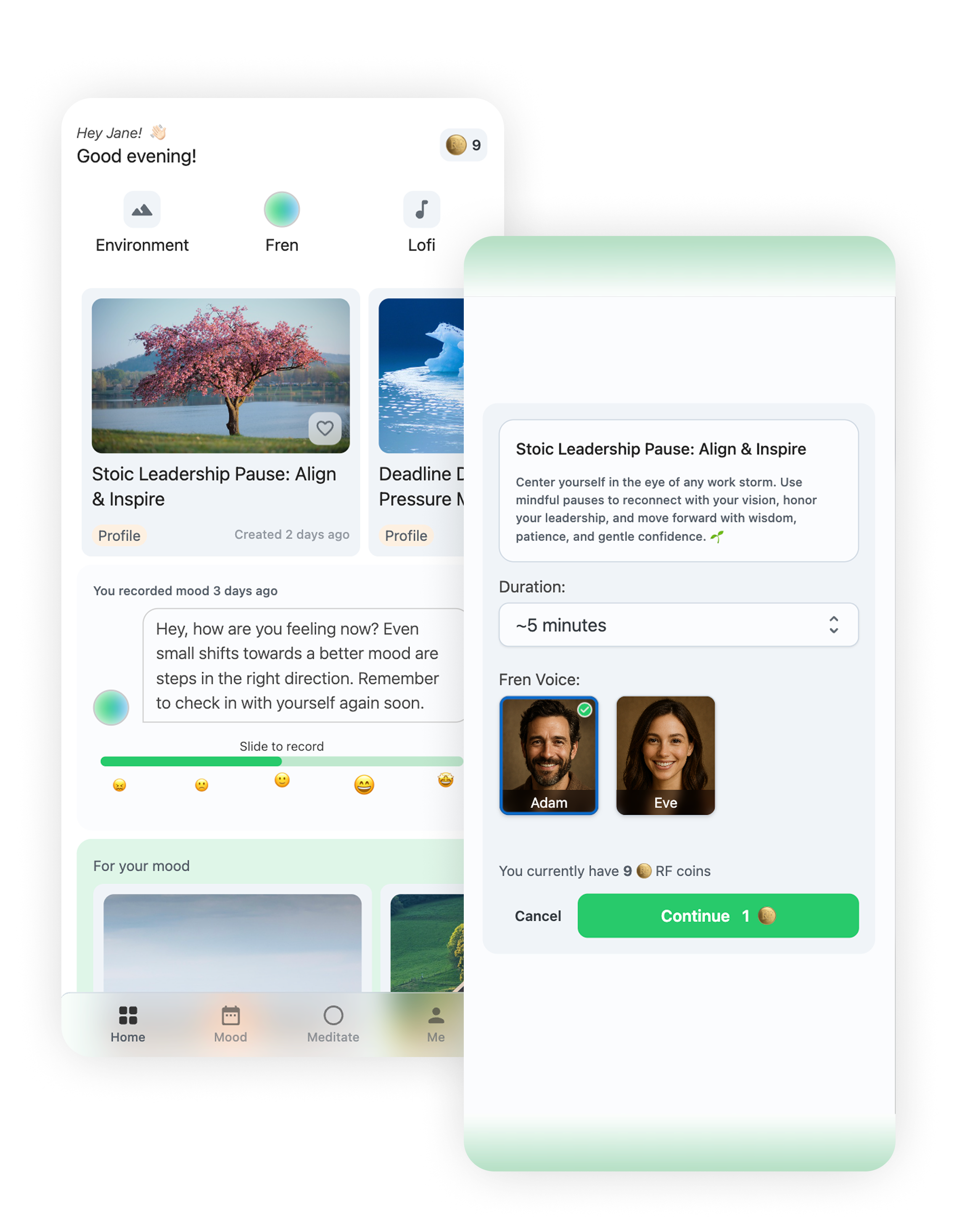
RelaxFrens uses AI to personalize meditation sessions based on your mood, time of day, and attention patterns. For focus work, the app recommends shorter, more structured sessions that work better for ADHD brains and busy schedules. The guided meditations provide the external structure needed to maintain attention.
Pre-Work Meditation Reminders
Set up reminders for pre-work meditation sessions that help you transition into focus mode. RelaxFrens learns your schedule and suggests optimal meditation times—like right before your most important work blocks—to maximize productivity benefits.
Short Session Options
RelaxFrens offers meditation sessions as short as 2 minutes, perfect for ADHD-friendly practice and quick focus resets during work. These micro-sessions can be done between tasks, during Pomodoro breaks, or before important meetings to enhance clarity and decision-making.
Start Your Focus Meditation Practice Today
Meditation for focus isn't about achieving perfect stillness—it's about training your brain to maintain attention, resist distractions, and enter flow state more easily. Whether you have ADHD, struggle with distractions, or want to boost productivity, the techniques in this guide can help you develop a meditation practice that actually works for your brain.
Remember: consistency matters more than perfection. Start with 2-5 minute sessions, use ADHD-friendly techniques like walking meditation or body scans, experiment with focus sounds, and integrate meditation into your work routine. The benefits compound over time—each session strengthens your ability to focus and enter flow state.
For those with ADHD, remember that meditation doesn't have to mean sitting still. Movement-based meditation, short structured sessions, and guided meditations with clear anchors can make meditation accessible and effective. The goal isn't to eliminate thoughts or achieve perfect focus—it's to train your attention muscle, one session at a time.
Enhance Your Focus with RelaxFrens
Start your focus meditation practice with RelaxFrens. Get personalized meditation sessions, access to focus sounds (binaural beats, nature sounds, ambient music), and reminders that help you integrate meditation into your work routine for maximum productivity.
Get Started✓ Focus Sounds Library • ✓ ADHD-Friendly Sessions • ✓ Pre-Work Meditations • ✓ Personalized Guidance
Your ability to focus is a skill that can be trained and improved. Meditation is one of the most effective tools for developing this skill. Start today with a 2-minute session, experiment with different techniques and sounds, and discover what works best for your unique brain. With consistent practice, you'll find yourself entering flow state more easily, maintaining focus for longer periods, and working with greater clarity and efficiency.
The path to better focus starts with a single meditation session. Don't wait for the perfect time or conditions—start now, start small, and let the practice grow naturally. Your future focused self will thank you.
If this was useful, pass it along to someone who might need it.

Start a personalised meditation practice
An AI meditation app that builds customised sessions for your mood, stress, and sleep.
Ready to try a personalised meditation app?
RelaxFrens is an AI meditation app that creates customised sessions for your mood, stress, and sleep — not a fixed catalogue of the same tracks.
30-day money-back guarantee · Cancel anytime