Headspace vs Calm: Which Meditation App Is Better?
Comprehensive comparison of Headspace vs Calm meditation apps. Discover features, pricing, user reviews, and why RelaxFrens offers superior personalization compared to Headspace and Calm.
By RelaxFrens Team
January 28
15 min read
You're looking for a meditation app, and two names keep coming up: Headspace and Calm. Both Headspace and Calm have millions of users, celebrity endorsements, and impressive marketing campaigns. But when it comes to choosing between Headspace vs Calm, which one actually delivers the meditation experience you need?
In this comprehensive Headspace vs Calm comparison, we'll break down everything you need to know: features, pricing, user reviews, content quality, and most importantly—which app actually adapts to you. Because while both Headspace and Calm offer meditation content, neither truly personalizes your experience. That's where the conversation gets interesting.
Headspace vs Calm: Quick Comparison
Headspace vs Calm: At a Glance
Pricing: Headspace vs Calm
Headspace
$69.99/year
Available on App Store
Calm
$69.99/year
Available on App Store
Content Approach: Headspace vs Calm
Headspace
Structured courses, animated guides, educational focus
Calm
Sleep stories, music, celebrity narrators, variety focus
Personalization: Headspace vs Calm
Headspace
Pre-recorded sessions, no mood adaptation, same content for all users
Calm
Pre-recorded sessions, no mood adaptation, same content for all users
Headspace: Structured Learning for Beginners
Headspace positions itself as the educational meditation app. Founded by former Buddhist monk Andy Puddicombe, Headspace focuses on teaching meditation fundamentals through structured courses and animated guides.
What Headspace Does Well
Structured Learning: Headspace offers clear progression paths for beginners, making it easy to build a meditation habit.
Educational Content: Headspace explains meditation concepts clearly, helping users understand the “why” behind practices.
Animated Guides: Headspace's visual guides make meditation concepts accessible and engaging.
Focus Packs: Headspace offers themed meditation packs for specific goals like sleep, stress, or focus.
Where Headspace Falls Short
No Personalization: Headspace uses pre-recorded sessions that are identical for all users. The meditation you hear on Monday is the same meditation thousands of others hear—it doesn't adapt to your mood or emotional state.
Repetitive Content: After using Headspace for a few weeks, sessions start feeling scripted and repetitive. Users report hearing the same phrases and structures repeatedly.
No Mood Adaptation: Headspace doesn't adjust sessions based on your current emotional state. Whether you're anxious, stressed, or calm, you get the same pre-recorded session.
Limited Emotional Connection: Headspace sessions feel educational but often lack emotional resonance. Users report feeling disconnected from the content over time.
Calm: Variety and Entertainment
Calm takes a different approach than Headspace. Instead of structured courses, Calm emphasizes variety—sleep stories narrated by celebrities, music playlists, and a wide range of meditation styles.
What Calm Does Well
Sleep Stories: Calm offers extensive sleep story content narrated by celebrities like Matthew McConaughey and LeBron James, making bedtime more engaging.
Content Variety: Calm provides diverse meditation styles, music, and soundscapes, offering something for different preferences.
Entertainment Value: Calm makes meditation feel more like entertainment, which can help users who find traditional meditation boring.
Music Integration: Calm offers music playlists and soundscapes that complement meditation sessions.
Where Calm Falls Short
No Personalization: Like Headspace, Calm uses pre-recorded content that's identical for all users. The sleep story you hear is the same story thousands of others hear—it doesn't adapt to your emotional state or preferences.
Lack of Structure: While Calm offers variety, it lacks the structured learning path that Headspace provides. Users can feel overwhelmed by choice without clear guidance.
No Mood Adaptation: Calm doesn't adjust content based on your current emotional state. Whether you're anxious, stressed, or calm, you get the same pre-recorded session.
Repetitive Experience: Users report that Calm sessions start feeling repetitive after extended use. The variety becomes predictable, and sessions lose emotional impact.
The Personalization Problem: Why Both Headspace and Calm Fall Short
Here's the fundamental issue with both Headspace and Calm: neither app truly personalizes your meditation experience. Both Headspace and Calm use pre-recorded content that's identical for all users. Whether you're feeling anxious, stressed, energized, or calm, you get the same meditation session that thousands of others are hearing at the same moment.
The Personalization Gap in Headspace vs Calm
Pre-Recorded Content: Both Headspace and Calm use pre-recorded meditation sessions. The session you hear on Monday morning is identical to the session thousands of other users hear—it doesn't adapt to your mood, stress level, or emotional state.
No Mood Adaptation: Neither Headspace nor Calm adjusts sessions based on your current emotional state. If you're feeling anxious, you get the same “anxiety meditation” that someone else gets—even if their anxiety is different from yours.
No Learning: While Headspace and Calm may track your usage, neither app learns your emotional patterns or adapts content accordingly. Your meditation experience doesn't evolve with you.
Generic Experience: Both Headspace and Calm offer a one-size-fits-all approach. The meditation you need on a stressful Tuesday afternoon is the same meditation someone else gets on a calm Sunday morning.
This is why users are leaving both Headspace and Calm. Trustpilot reviews show Calm at 1.6⭐ and Headspace at 1.5⭐, with common complaints about sessions feeling scripted, repetitive, and disconnected from users' actual emotional needs.
What Users Are Saying: Headspace vs Calm Reviews
User reviews reveal the core problem with both Headspace and Calm. Here's what real users are saying:
Common Complaints About Headspace
Common Complaints About Calm
RelaxFrens: The Personalized Alternative to Headspace and Calm
While both Headspace and Calm offer meditation content, neither truly personalizes your experience. That's where RelaxFrens differs fundamentally from both Headspace and Calm.
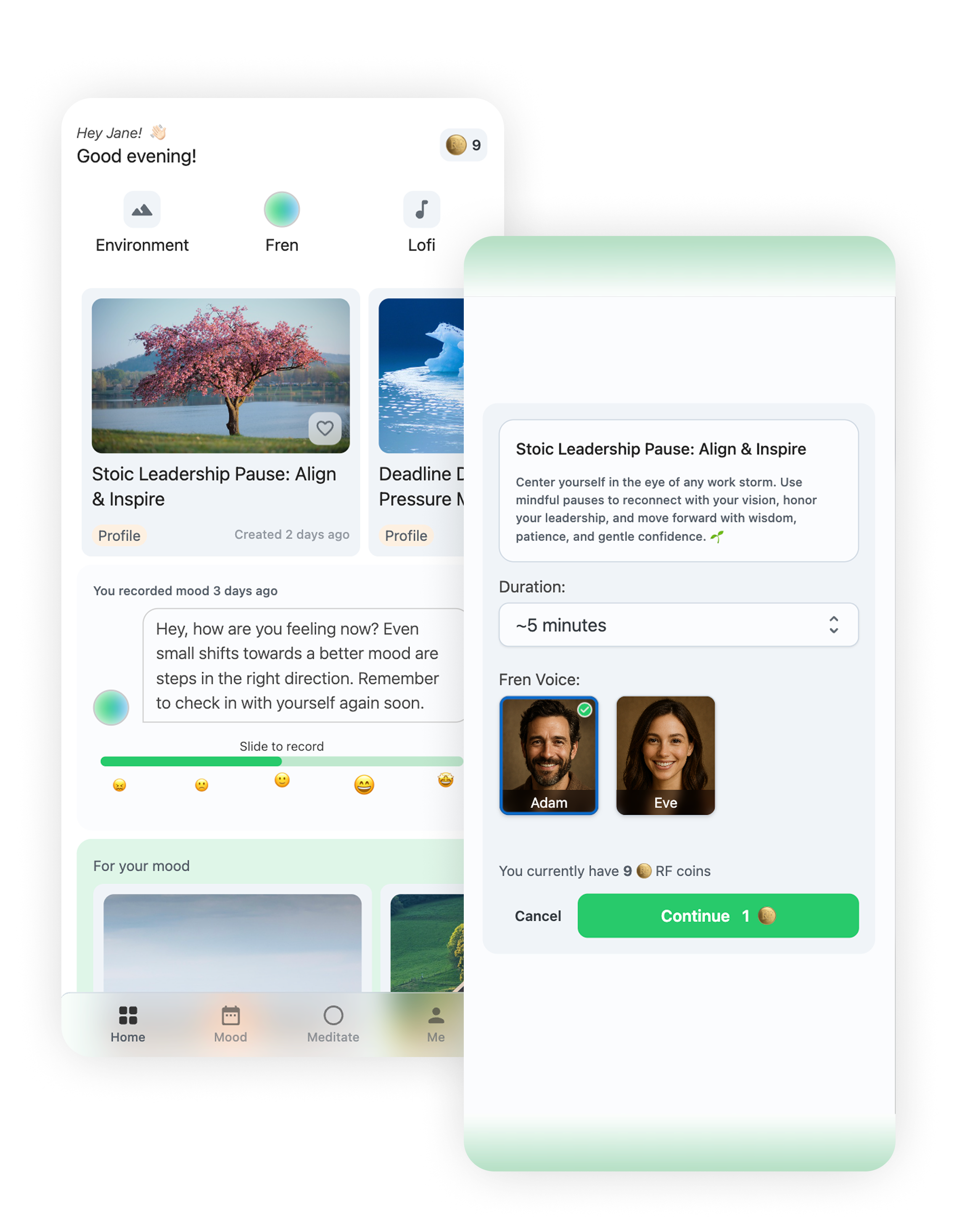
Unlike Headspace and Calm, which use pre-recorded content, RelaxFrens uses AI to generate unique meditations based on your current mood, emotional state, and personal patterns. Every session is created specifically for you, adapting to your needs in real-time.
Ready to Experience Personalized Meditation?
Try RelaxFrens and discover the difference of AI-powered personalized meditation. Get meditations that adapt to your mood, stress levels, and goals—unlike Headspace and Calm's one-size-fits-all approach.
Get Started with RelaxFrensHow RelaxFrens Compares to Headspace vs Calm
AI-Generated Meditations (vs Pre-Recorded)
Headspace vs Calm: Both use pre-recorded sessions that are identical for all users.
RelaxFrens: AI generates unique meditations based on your chat, current mood, and focus area. Every session is created specifically for you, unlike Headspace and Calm which offer the same content to everyone.
Mood Analytics & Learning (vs Static Content)
Headspace vs Calm: Neither app learns your emotional patterns or adapts content accordingly.
RelaxFrens: The app learns how your emotions change daily, tracks patterns, and adapts recommendations accordingly. Unlike Headspace and Calm, your meditation experience evolves with you.
Emotional Tone Adaptation (vs Generic Narration)
Headspace vs Calm: Both use generic narration that doesn't adapt to your emotional state.
RelaxFrens: Fren's tone changes based on your emotional data. When you're anxious, Fren speaks with calm reassurance. When you're energized, Fren matches that energy. Unlike Headspace and Calm, the experience adapts to meet you where you are emotionally.
Personalized Scheduling (vs Generic Recommendations)
Headspace vs Calm: Both offer generic recommendations that don't adapt to your schedule or emotional patterns.
RelaxFrens: Three personalized meditations unlock at specific times throughout your day, creating rhythm and anticipation. Unlike Headspace and Calm, sessions are timed to your optimal meditation windows.
Custom Soundscapes (vs Fixed Audio)
Headspace vs Calm: Both offer fixed audio tracks that don't adapt to your preferences or mood.
RelaxFrens: Combine lo-fi, rain, dunes, or ocean sounds to match your vibe. Unlike Headspace and Calm, you control the ambient audio that accompanies your meditation.
Headspace vs Calm vs RelaxFrens: Feature Comparison
Headspace vs Calm vs RelaxFrens: Complete Feature Comparison
Personalization
Headspace
Pre-recorded content
Calm
Pre-recorded content
RelaxFrens
AI-generated meditations
Content Type
Headspace
Structured courses, animated guidesCalm
Sleep stories, music, varietyRelaxFrens
AI-generated, personalized sessionsMood Adaptation
Not available
Not available
Real-time adaptation
Learning & Analytics
Basic usage tracking
Basic usage tracking
Mood analytics & pattern learning
Headspace vs Calm: The Verdict
When comparing Headspace vs Calm, both apps have their strengths. Headspace excels at structured learning for beginners, while Calm offers more variety and entertainment value. However, both Headspace and Calm share the same fundamental limitation: neither app truly personalizes your meditation experience.
Both Headspace and Calm use pre-recorded content that's identical for all users. Whether you're feeling anxious, stressed, energized, or calm, you get the same meditation session that thousands of others are hearing. This lack of personalization is why users are leaving both Headspace and Calm—they want meditation that adapts to them, not generic content that treats everyone the same.
If you're choosing between Headspace vs Calm, consider what you actually need: Do you want structured learning? Choose Headspace. Do you want variety and entertainment? Choose Calm. But if you want meditation that truly adapts to your mood, learns your patterns, and evolves with you? That's where RelaxFrens offers something neither Headspace nor Calm can provide.
Experience Personalized Meditation Beyond Headspace vs Calm
While Headspace and Calm offer pre-recorded content, RelaxFrens uses AI to generate unique meditations that adapt to your mood, learn your patterns, and evolve with you. Experience meditation that's truly personalized—not generic.
Try RelaxFrens Free✓ AI-Generated Meditations • ✓ Mood Analytics • ✓ Real-Time Adaptation • ✓ Personalized Scheduling
The choice between Headspace vs Calm comes down to preference—structured learning or variety. But if you want meditation that truly knows you, adapts to you, and evolves with you, RelaxFrens offers personalization that neither Headspace nor Calm can match.
If this was useful, pass it along to someone who might need it.

Start a personalised meditation practice
An AI meditation app that builds customised sessions for your mood, stress, and sleep.
Ready to try a personalised meditation app?
RelaxFrens is an AI meditation app that creates customised sessions for your mood, stress, and sleep — not a fixed catalogue of the same tracks.
30-day money-back guarantee · Cancel anytime