5-Minute Meditation for Busy People: Quick Mindfulness Routines That Actually Work
You don't need 30 minutes. Five minutes of the right practice, done consistently, produces real and measurable mental health benefits — here's exactly how.
By RelaxFrens Team
June 20, 2026
11 min read
"I don't have time to meditate." It's the most common reason people give — and it's based on a misconception. Meditation isn't a 30-minute morning ritual you need to wake up earlier for. It's a mental skill that strengthens with use, and like a muscle, it responds to short consistent sessions far better than it does to occasional long ones.
Research backs this up. A 2018 study in Psychological Science found that 13 minutes of daily mindfulness over 8 weeks improved attention, working memory, and emotional regulation. Other studies show measurable cortisol reduction from single sessions as short as 5 minutes. If you have time to scroll your phone, you have time to meditate. This guide gives you five complete 5-minute routines you can start today — at your desk, in your car, or between meetings. For more context on how AI apps can make this even easier, see how meditation apps for busy professionals are designed around your schedule.
The Science: Why 5 Minutes Is Enough
5 minutes lowers cortisol
Even brief breathwork sessions produce measurable reductions in salivary cortisol — the primary stress hormone — within a single 5-minute practice.
Short sessions build the same skill
The neurological training effect of meditation (strengthening the prefrontal cortex, quieting the default mode network) accumulates with repetition, not with session length. Daily 5-minute sessions outperform weekly 30-minute sessions.
Brief mindfulness improves task performance
A 2-3 minute mindfulness break before a cognitively demanding task measurably improves performance on that task by reducing stress interference and restoring attentional resources.
Small wins create habit momentum
Starting with 5 minutes removes the psychological resistance that prevents people from starting. A streak of 30 consecutive 5-minute sessions creates stronger habits than sporadic 30-minute sessions.
5 Complete 5-Minute Meditation Routines
Box Breathing (Works Anywhere, Zero Setup)
Best for: Before meetings, during commute, at your desk
1
Set a 5-minute timer on your phone.
2
Inhale through nose for 4 counts.
3
Hold for 4 counts.
4
Exhale through mouth for 4 counts.
5
Hold empty for 4 counts.
6
Repeat continuously until timer ends.
Note: This is the Navy SEAL method used to maintain performance under extreme stress. Eyes can be open or closed. Posture doesn't matter.
5-4-3-2-1 Sensory Grounding
Best for: During anxiety spikes, overwhelm, or rumination
1
Name 5 things you can see around you.
2
Touch 4 things and notice their texture.
3
Listen carefully for 3 distinct sounds.
4
Identify 2 things you can smell.
5
Notice 1 thing you can taste.
6
Take 5 slow deep breaths to close.
Note: Especially effective for people with anxious minds that resist breath focus. The sensory richness crowds out anxious thought.
Counting Breath Meditation
Best for: Morning start, pre-work wind-up, mental reset
1
Sit comfortably, close your eyes or soften your gaze.
2
Begin breathing naturally.
3
Count each exhale: 1, 2, 3... up to 10.
4
When you reach 10, start again at 1.
5
If you lose count, gently start from 1.
6
Continue for 5 minutes.
Note: The counting gives your busy mind a task. Every time you lose count and return to 1 is a successful mindfulness moment.
Rapid Body Check-In
Best for: Between calls, after stressful interactions, pre-lunch
1
Close your eyes and take 3 slow breaths.
2
Notice your head and face — any tension? Soften.
3
Notice your shoulders and neck — release them down.
4
Notice your chest and belly — is your breathing shallow?
5
Notice your hands — clench and release.
6
Take 3 final slow breaths, then open your eyes.
Note: This 5-minute version of a body scan interrupts the accumulation of physical tension throughout the workday.
AI-Guided Micro-Session
Best for: Whenever you want optimal personalization
1
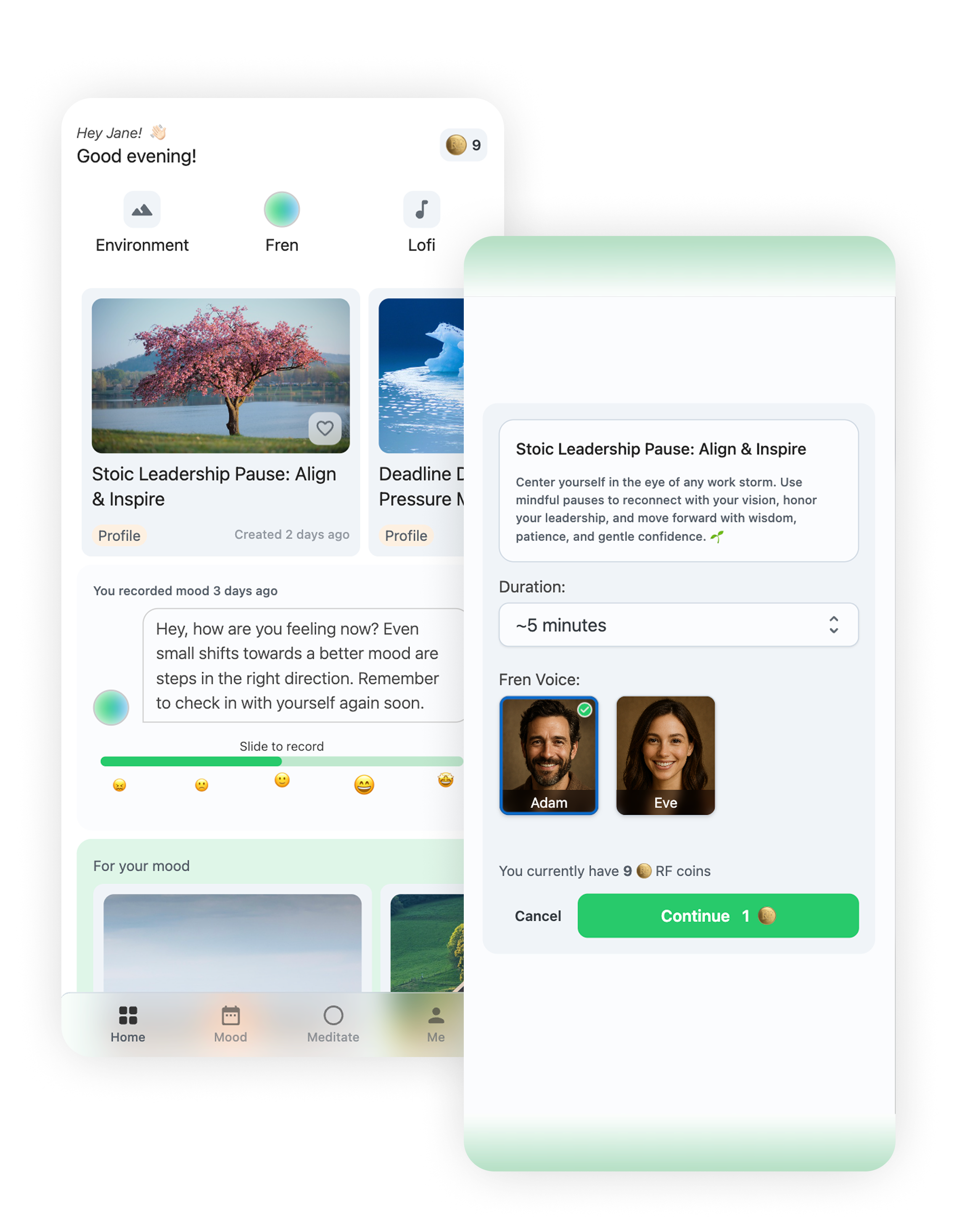
Open RelaxFrens or your preferred meditation app.
2
Select 'Quick Session' or '5 minutes'.
3
Input your current mood or stress level.
4
Follow the AI-generated guidance.
5
The app selects the optimal technique for your current state.
6
Close the app and notice the difference.
Note: AI apps adapt to your current stress level and time available — so the 5 minutes you get is always the most relevant 5 minutes for where you are right now.
The Secret: Habit Stacking
The hardest part of meditation isn't the practice itself — it's remembering to do it. Habit stacking solves this by attaching meditation to an existing reliable trigger rather than trying to create a new standalone habit:
While coffee brews
Box breathing or counting breaths (exactly long enough for a cup)
Before your first work meeting
5-4-3-2-1 grounding to arrive present rather than scattered
After lunch, before afternoon work
Rapid body check-in to reset from food coma
During commute (passenger) or commute (driver at red lights)
Breath counting or body awareness
Before bed, phone plugged in across the room
Box breathing or self-compassion phrases
Frequently Asked Questions
Can 5 minutes of meditation really make a difference?
Yes. Research shows that even brief mindfulness sessions produce measurable physiological effects. A 2018 study found 13 minutes of daily meditation over 8 weeks improved attention, memory, mood, and emotional regulation. Consistency matters more than duration.
What is the best 5-minute meditation for beginners?
Box breathing (4-4-4-4 pattern) or counting breaths are the most accessible 5-minute practices for beginners. They have clear structure, require no experience, and produce immediate calming effects.
How do I find time to meditate when I'm too busy?
Use habit stacking — attach meditation to an existing trigger. Meditate while your coffee brews, during commute, before your first meeting, or in any transition moment. You don't need to carve out separate time.
Your First 5-Minute Session Starts Now
RelaxFrens offers AI-personalized sessions as short as 3 minutes — adapting to your schedule, energy level, and goals. The best meditation app for people who think they have no time.
Conclusion
Five minutes. That is all that stands between you and a consistent meditation practice that measurably improves your attention, stress resilience, and emotional regulation. The five routines in this guide are your toolkit — choose one today, stack it onto an existing habit, and repeat it tomorrow.
For ADHD-specific adaptations of these short practices, read our guide to meditation for ADHD. And to build up toward a fuller practice over time, see mindfulness techniques for busy professionals.
If this was useful, pass it along to someone who might need it.

Start a personalised meditation practice
An AI meditation app that builds customised sessions for your mood, stress, and sleep.
Ready to try a personalised meditation app?
RelaxFrens is an AI meditation app that creates customised sessions for your mood, stress, and sleep — not a fixed catalogue of the same tracks.
30-day money-back guarantee · Cancel anytime